Choosing Marble for Sculpture, Architecture and Landscape
Marble is the only material here that is subtracted rather than added: every piece is carved from a solid block, so the stone itself sets the limits on scale, pose and detail. That makes stone selection the first real decision in any marble commission, ahead of design. Below is how we work through it with architects, hotels, churches and private clients — which marble to use, what it costs to keep, and what the process looks like from block to installed statue.
The Marbles We Carve In
White marbles
Hebei white and Guangxi white are our workhorses for figures and columns: fine, even grain, consistent supply, good value. Bianco Carrara gives a slightly warmer white with soft grey veining. Statuario and Calacatta are the premium whites, with dramatic veining that suits abstract and architectural pieces more than faces, because heavy veining fights fine facial detail.
Coloured and veined marbles
Beige, cream, Emperador brown, Rosso Verona red, Nero Marquina black and green marbles are used for columns, fireplaces, fountains, altars and inlay. Availability varies block by block, so we reserve stone before quoting on anything colour-critical.
Granite and limestone alternatives
For exposed outdoor sites with acid rain, freeze-thaw cycles or heavy public contact, granite is significantly more durable than marble and we will say so. Limestone sits between the two and suits period architectural work.
What We Carve
Figurative statues
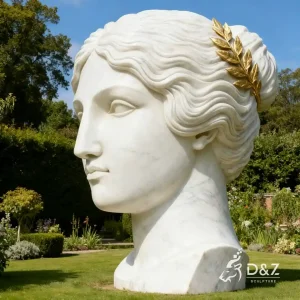
Religious figures, classical and Roman-Greek subjects, portraits, angels and saints. Hand-carved by sculptors, with CNC roughing only on the waste stone.
Fountains and water features
Tiered, wall and basin fountains. Water is hard on stone, so joints, plumbing routes and a sealed basin detail all get designed in rather than improvised on site.
Architectural elements
Columns, capitals, balustrades, door surrounds, fireplaces, altars, pulpits and gazebos, cut to your architect’s drawings and dry-assembled in our yard before shipping.
Relief and wall panels
Low and high relief panels for lobbies, memorials and religious interiors.
Hand Carving, CNC and Why the Mix Matters
A five-axis CNC can remove waste stone quickly and accurately, which lowers cost and shortens lead times. What it cannot do is the last few millimetres: the tool marks on a face, the undercut in drapery, the softness of a hand. We use CNC for roughing and repeat architectural profiles and hand-finish everything that will be looked at closely. If a supplier quotes a fully machined figure at an unusually low price, that is what you are giving up.
Outdoors: What Marble Does Over Time
Marble is calcium carbonate and acid dissolves it. In a polluted city or an area with acid rain, a white marble figure will lose crispness over decades and can develop a sugary surface. In freeze-thaw climates, water in the stone expands and can spall edges. None of this makes marble a bad outdoor choice — Europe is full of 400-year-old marble statues — but it means sheltered placement, good drainage under the base, an impregnating sealer refreshed every three to five years, and a winter cover in hard-frost regions are worth doing. Where those cannot be guaranteed, granite is the better specification.
Weight, Foundations and Handling
Marble runs about 2,700 kg per cubic metre. A life-size solid figure is commonly 800-1,500 kg, a large fountain several tonnes in multiple sections. That drives everything downstream: crane access, foundation depth, floor loading in an interior. We provide sectional weights, lifting points and foundation loads with the drawings, and we crate in steel-banded timber with the stone supported on its natural bedding plane.
Marble Sculpture FAQ
How long does a custom marble statue take?
Usually three to six months: block sourcing and clay or 3D model approval first, then 60-120 days of carving and finishing for a life-size figure. Large fountains and architectural packages run longer.
Can I approve the actual block before carving?
Yes, and on veined or coloured stone we recommend it. We photograph candidate blocks and slab faces for your approval before cutting.
Will the marble yellow?
White marble can take on a warm tone outdoors from iron in the stone and from organic staining. Sealing on delivery and rinsing annually largely prevents it; existing staining can usually be poulticed out.
Can you carve from my architect’s drawings or a 3D file?
Yes. We work from CAD, 3D scans, photographs or physical maquettes, and return our own model for approval before any stone is cut.