Specifying Stainless Steel Sculpture for Outdoor Sites
Stainless steel is the material most contemporary outdoor sculpture is made from, and for good reason: it holds a mirror finish for decades, needs almost no maintenance, and can be formed into large hollow volumes that would be impossibly heavy in bronze or stone. The decisions that actually matter are the grade, the finish, the wall thickness and the internal frame. Get those right and the piece outlives the building next to it.
304 or 316 — the One Spec Decision That Matters Most
304 stainless is cheaper and perfectly adequate inland, away from de-icing salt and industrial air. 316 contains molybdenum, which resists chloride pitting; it is the correct grade for anything within roughly 5 km of the sea, beside a swimming pool, in a road corridor that is salted in winter, or in a heavily polluted city. The cost difference on a finished sculpture is usually 8-15 percent. The cost of replacing a pitted mirror-polished surface is the whole piece. We quote 316 by default for coastal and poolside projects and will tell you when 304 is genuinely enough.
Finishes and How They Age
Mirror polish
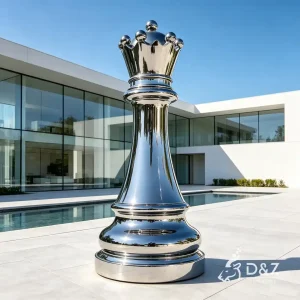
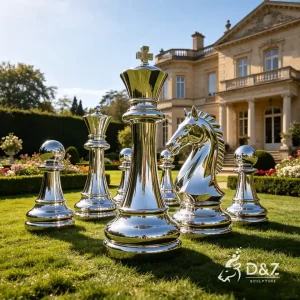
The signature contemporary look: the sculpture disappears into reflections of sky, water and surrounding architecture. Needs washing two to four times a year to stay sharp, and shows fingerprints at hand height. Best on smooth, flowing forms.
Brushed / satin (No.4 or hairline)
Directional matte grain. Far more forgiving of dust, water spotting and minor handling marks than mirror, and reads as calmer in a landscape setting. A good choice for pieces people will touch.
Coloured PVD and titanium plating
An ion-bonded metallic colour layer — gold, rose, champagne, bronze, black, blue. Far more durable than paint and will not fade in UV, but a deep scratch cannot be locally repolished. Excellent for hotel and retail work.
Painted or powder-coated stainless
Used when a specific RAL colour is non-negotiable. The stainless substrate means that even if the coating is damaged, there is no structural rust behind it.
How Thick Should the Skin Be?
Thin plate saves money and buys nothing. As a working guide we use 1.5-2 mm on pieces up to about 2 m, 2-3 mm from 2-5 m, and 3-5 mm above 5 m or anywhere the public can lean on the work. Below those figures, large flat panels oil-can — they ripple visibly in raking light — and on a mirror finish that ripple is the first thing anyone sees. Complex double-curved forms can go thinner than flat ones because the curvature itself adds stiffness.
Every piece over about 1.5 m gets an internal stainless or galvanised frame that carries the load, with the skin attached to it. The frame, not the skin, is what the wind calculation is run against.
Wind, Anchoring and Foundations
A large hollow stainless sculpture is light and has a big sail area, which makes uplift and overturning the governing loads rather than weight. We calculate wind pressure to your local code, size the base plate and anchor bolts, and give your civil engineer the foundation loads. Typical solutions are a cast-in anchor cage in a reinforced concrete pad, or a bolted base plate on a pre-formed plinth. We supply the setting-out template so the bolts are in exactly the right place before the piece arrives.
Lighting Stainless Steel Sculpture
Mirror finishes reflect rather than glow, so flooding one with light usually fails. Grazing light from close to the base, concealed uplights washing an adjacent wall, or integrated LED lines inside a perforated or split form all work far better. Tell us at design stage if the piece will be lit and we will build the conduit routes and driver access into the structure rather than drilling later.
Maintenance — Realistically
Wash with clean water and a little pH-neutral detergent, rinse, and dry with a soft cloth to avoid water spots. Two to four times a year is enough inland, four to six on a coast. Never use steel wool, chlorine-based cleaners or anything abrasive: iron particles embedded in the surface are what cause the brown speckling people mistake for the stainless itself rusting. Light scratches in a mirror finish can be polished out on site; we supply the compound grade to use.
Stainless Steel Sculpture FAQ
Will stainless steel rust outdoors?
Correctly specified, no. Brown staining is almost always surface contamination from nearby steel grinding, rail dust or the wrong cleaning materials, and it washes off. True pitting happens when 304 is used in a chloride environment where 316 was needed.
How large can you build?
We regularly produce pieces of 10-15 m and have delivered larger in sections with concealed site welds and on-site repolishing.
Can you work from an artist’s or architect’s model?
Yes — a large part of our stainless work is fabrication from client 3D files, drawings or physical maquettes, under NDA where required.
How long does production take?
Roughly 25-45 days for a piece up to 3 m, 45-80 days for larger or mirror-polished work. Mirror polishing is the slowest stage and cannot be rushed without showing.