Urban Sculpture That Works at City Scale
Urban sculpture is public art that has to survive the public. It sits in squares, on street corners, at city gateways and outside transport hubs, where it is touched, climbed, photographed, salted in winter and washed by street cleaners. D&Z has manufactured urban sculpture for municipalities, developers and landscape architects in more than 60 countries, and the pieces below are built to that standard: engineered for wind and impact loads, finished to resist graffiti and weather, and supplied with the drawings your contractor and structural engineer will ask for.
Types of Urban Sculpture We Manufacture
City gateway and entrance markers
Large-scale landmark pieces placed at the approach to a city or district. Usually 6-15 m, usually stainless steel or Corten, usually lit. These are the most engineering-heavy projects we take on because of wind exposure and sightline requirements.
Square and plaza centrepieces
Free-standing works designed to be walked around at 360 degrees. Scale is set by the plaza, not the budget: a piece under 3 m disappears in a 60 m square.
Street furniture sculpture
Benches, planters, bollards and shade structures that are sculptural objects as well as functional ones. Popular in retail streets and waterfront promenades.
Interactive and kinetic works
Wind-driven, water-driven or hand-turned pieces. They draw the most engagement and need the most maintenance planning, so we specify sealed bearings and accessible service points from the outset.
Commemorative and identity pieces
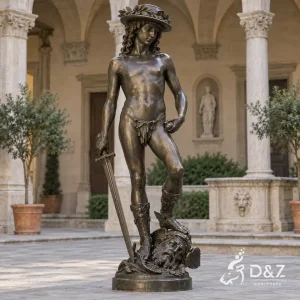
Figurative or symbolic works marking a person, event or industry. Bronze is the default for these; it ages well and reads as permanent.
Choosing a Material for a Public Site
316 stainless steel
The default for contemporary urban work. Mirror-polished stainless reflects the surrounding city, which keeps large volumes from feeling heavy. Specify 316, not 304, anywhere within a few kilometres of the coast or on a road that is salted in winter.
Corten weathering steel
Self-protecting rust patina, no coating to maintain, strong in landscape settings. Be aware of runoff staining on pale paving for the first two to three years; we detail a drip edge and recommend a gravel or dark stone base.
Cast bronze
Best for figurative and commemorative work. Effectively permanent, patinas slowly, and repairs are straightforward decades later.
Painted carbon steel and aluminium
The cheapest route to bold colour. Budget for a repaint every 8-12 years in an urban environment, sooner in a coastal one.
Scale, Sightlines and Setting Out
The most common mistake in urban sculpture briefs is under-scaling. A useful starting rule: the piece should read clearly from the furthest point a pedestrian normally approaches it. For a plaza, that usually means a height of roughly one-tenth to one-eighth of the open span. For a roundabout or gateway, the driver’s viewing distance and speed set the minimum, and 8 m is often the floor rather than the ceiling.
We model every project in 3D against your site photographs or survey before anything is cut, so you can see the piece at the real viewing distances and adjust before production.
Engineering, Anchoring and Approvals
Public installations almost always need stamped structural documentation. We provide wind-load calculations to your local code, base-plate and anchor-bolt layouts, foundation loading figures for your civil engineer, and weld and material certificates. For seismic zones we design to the relevant importance factor and detail the connection accordingly.
Anti-climb and impact considerations matter as much as wind: we round or guard low-level edges, specify tamper-proof fixings, and can apply an anti-graffiti sacrificial coating on any surface within reach.
Working With D&Z on an Urban Commission
1. Brief and site information
Send site photographs, dimensions, any planning constraints and reference images. A rough budget range saves everyone time.
2. Free 3D design
We produce concept renders placed in your site context, at no cost, and revise until the form is right.
3. Engineering and approval package
Structural calculations, foundation drawings and material certificates issued for your consultant’s review.
4. Fabrication
Typically 30-70 days depending on scale and finish. Progress photographs at each stage; clients are welcome to inspect.
5. Crating, shipping and installation
Export-grade crating, freight and customs handled end to end. We supply an installation manual and provide remote or on-site supervision.
Urban Sculpture FAQ
How long does a large urban sculpture take?
Allow three to five months from approved design to delivery for a 6-10 m piece, plus shipping time. Rush schedules are possible but affect finishing quality on polished work.
Do you provide stamped engineering drawings?
Yes. We supply wind-load calculations, anchor layouts and foundation loads. Local stamping by a registered engineer in your jurisdiction is usually required and we support that process.
What maintenance will the city need to budget for?
Mirror stainless: wash two to four times a year. Corten: none. Painted steel: inspect annually, repaint every 8-12 years. Bronze: wax every one to two years if you want to hold the patina.
Can you match an artist’s design rather than your catalogue?
Yes. A large share of our urban work is fabrication for architects and artists from their own drawings or maquettes, under NDA where required.